How Are Nicotine Pouches Manufactured? From Raw Material to Can
Short answer: a nicotine pouch starts as a controlled mixture of nicotine, bulking agents, pH adjusters, flavourings and—depending on the product—water and humectants. The blend is homogenised and may be granulated or dried, dosed into permeable pouch material, heat-sealed, cut and packed. The released batch then has to meet defined controls for nicotine content, weight, moisture, pH, seal integrity and stability. Exact recipes and process technology differ between manufacturers.
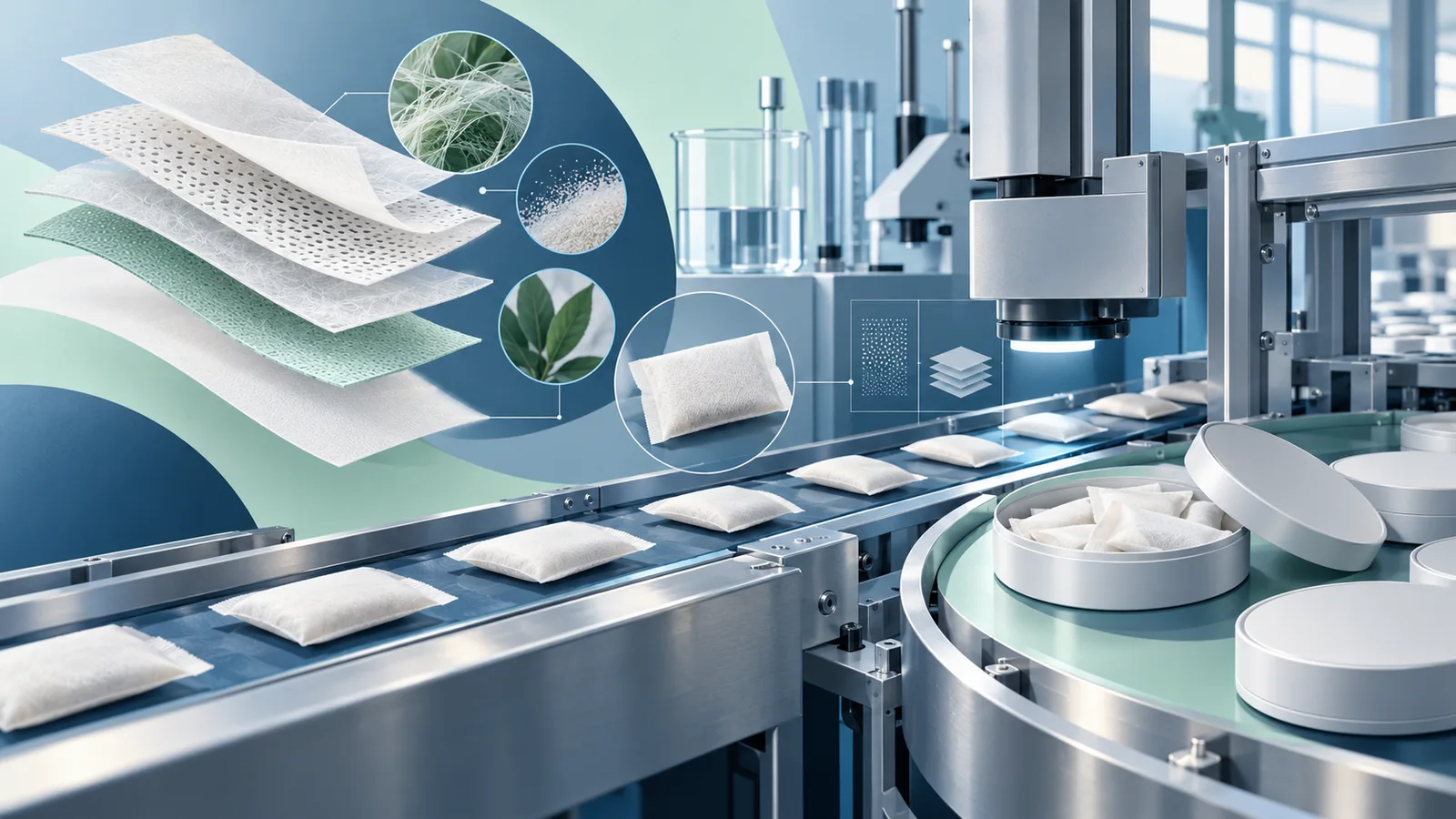
The process in seven stages
- Specification and raw-material control. The manufacturer defines nicotine per pouch, fill weight, moisture, pH, flavour profile and tolerances. Raw-material identity and quality have to be checked before use.
- Weighing and preparation. Nicotine or nicotine salt, cellulose or other bulking agents, binders, sweeteners, buffers and flavours are weighed to the batch formula. Nicotine requires dedicated dosing and occupational controls.
- Mixing. Powders and liquids are blended so nicotine and other components are distributed evenly. Homogeneity matters: a compliant batch average is not enough if individual pouches vary.
- Granulation, wetting or drying. Some formulations run as dry powders; others are sprayed with water or ethanol and granulated. Patent examples describe high-speed mixing and low-temperature drying, but they are examples rather than one universal industry method.
- Dosing into pouch material. The fill is fed to a machine that forms permeable nonwoven material, deposits a defined amount and keeps format and weight within tolerance.
- Sealing, cutting and packing. Material containing thermoplastic fibres can be heat-sealed. The continuous strand is cut into pouches, inspected, counted and packed into cans.
- Release and stability. The finished batch is tested against specification and a stability programme. A batch should not be released merely because the line produced the correct number of pouches.
What is in the filling?
| Component | Technical function | What has to be controlled |
|---|---|---|
| Nicotine or nicotine salt | Active ingredient | Identity, assay, uniform distribution and declared amount per pouch |
| Cellulose and other bulking agents | Volume, structure and liquid handling | Particle size, flow, bulk density and interaction with moisture |
| pH adjusters | Control the fill environment and influence the unprotonated nicotine fraction | Reproducible pH; flavour “sting” is not a measure of nicotine content |
| Binders and humectants | Granulation, consistency and moisture retention | Caking, flow, stability and microbiological conditions |
| Flavours and sweeteners | Flavour profile | Dose, compatibility, change over shelf life and market-specific rules |
| Pouch material | Contains the fill while allowing saliva and dissolved substances to pass | Seal strength, permeability, material identity and comfort |
Dry and moist pouches need different process windows
“Dry” and “moist” describe more than mouthfeel. Water and humectants affect powder flow, granulation, caking, microbiological control, pouch weight and dissolution. One patent example uses wet granulation followed by drying and particle classification. Another describes moist granulates with high levels of microcrystalline cellulose. These are possible technical routes, not disclosures of the recipes used for ZYN, VELO or other commercial products.
The pouch material is an engineered component
The material has to combine liquid permeability with a seam that survives production, transport and use. Patent documents describe blends of cellulose and thermoplastic fibres: cellulose contributes structure and liquid handling, while thermoplastic content enables heat sealing. Mini, slim and regular formats also require different fill weights and machine settings.
Equipment across a nicotine pouch line
A commercial line is a system rather than one machine. The exact configuration depends on whether the fill is dry-blended, wet-granulated or supplied as an intermediate, but the main equipment functions are consistent:
| Production function | Typical equipment role | Critical control |
|---|---|---|
| Receiving and dispensing | Contained weighing and material identification | Identity, lot traceability and dosing accuracy |
| Mixing and granulation | Homogeniser, blender and, where used, granulator | Blend uniformity, moisture and particle distribution |
| Drying and classification | Dryer, mill and sieve where the formulation requires them | Residual moisture, particle size and flow |
| Pouch forming and filling | Web handling, dosing, heat sealing and cutting | Fill weight, seam integrity, dimensions and line speed |
| In-line inspection | Checkweighing, vision inspection and rejection | Missing, leaking, damaged or incorrectly filled pouches |
| Can packing and coding | Counting, can filling, lid application and batch coding | Count, pack integrity and traceable codes |
| Laboratory release | Analytical and physical test equipment | Nicotine, pH, moisture, microbiology and stability |
No equipment list by itself proves that a line is qualified. Installation, calibration, cleaning, validated operating ranges, trained operators and documented batch release determine whether the process can repeatedly meet specification.
Quality control is part of manufacturing
FDA's PMTA rule requires a full description of manufacturing methods, facilities and controls. In FDA's technical review of Helix products, reviewers assessed the process flow, quality controls, standard operating procedures, work instructions and chemical stability. Parts are redacted as confidential commercial information. That distinction matters: an agency review may support that a control system was assessed without disclosing the recipe.
- nicotine content per gram and per pouch
- pouch weight and weight variation
- moisture or water activity where relevant
- pH and chemical stability
- microbiological results
- seal integrity, leakage and pouch count
- sensory and physical change over shelf life
From pilot batch to industrial scale
A laboratory blend that works is not automatically a robust production process. Scale changes mixing time, heat generation, particle movement, dosing precision and line speed. Philip Morris ČR describes end-to-end lines where externally sourced nicotine powder enters and packed, palletised cans leave; its report also says commercial start depended on microbiological results and technical training. Capacity, quality and workforce qualification therefore have to be validated together.
Five questions when selecting a manufacturer
- Which critical quality attributes are released for every batch, and what tolerances apply?
- How are homogeneity and nicotine per pouch verified, rather than nicotine per gram alone?
- Which stages are performed in-house and which raw materials or intermediates come from third parties?
- How is change control handled when a material, formula, machine or pack changes?
- What stability evidence supports the expiry date in each market?
Dry and moist are formulation choices, not quality grades
“Dry” and “moist” describe the product's water system and resulting release behaviour, not whether one pouch is better made. A drier fill can support flow, physical stability and a slower initial release. A moister fill may activate more quickly in the mouth but places more emphasis on caking control, seal performance and microbiological stability. Public product labels rarely disclose enough information to infer water activity, so a consumer-facing “moist” description should not be converted into a laboratory value.
| Property | Dryer formulation | Moister formulation | Control question |
|---|---|---|---|
| Powder flow | Often easier to meter if particles remain free-flowing | Can be more sensitive to agglomeration | Does fill weight remain uniform at production speed? |
| Initial release | Often depends on saliva entering the pouch first | Can begin more rapidly | What does the measured release profile show? |
| Stability | Moisture ingress can change texture and chemistry | Water activity and migration require tighter control | Does the pack preserve specification through shelf life? |
| Sensory effect | May feel slower or less wet | May feel faster or softer | Is sensation being kept separate from nicotine content? |
Quality control runs from receipt to shelf life
Finished-product testing alone cannot prove that every pouch was produced under control. A defensible programme links incoming-material identity, in-process controls, batch release and stability. FDA's PMTA requirements and the public Helix review show why process descriptions, specifications, procedures and chemical stability belong in the same evidence file.
| Stage | Examples of evidence | Decision supported |
|---|---|---|
| Incoming materials | Supplier qualification, identity, assay, lot and contaminant specifications | Whether the correct raw material may enter production |
| In process | Mix time, blend uniformity, moisture, fill weight, line speed and seal checks | Whether the process remains inside its validated range |
| Batch release | Nicotine per pouch, pH, pouch count, microbiology, appearance and seal integrity | Whether the lot meets the finished-product specification |
| Stability | Scheduled chemical, physical, microbiological and packaging tests | Whether the labelled shelf life remains supported |
Laboratory methods also need a defined purpose. Assay measures how much nicotine is present; content-uniformity sampling examines distribution between pouches; release testing studies how material leaves the pouch under stated conditions. None of those results alone proves human absorption or perceived strength. Our strength-standard guide explains why milligrams, pH, release and sensation must remain separate fields.
Raw materials, pouch web and the can form one system
The bill of materials extends beyond the fill. Nonwoven pouch material must allow liquid exchange while retaining particles and surviving forming, sealing and use. The heat-sealable fibre composition, web thickness and seam geometry interact with machine settings. Patents can document possible technical solutions, but they do not establish which commercial product uses a given material.
The can and closure then have to preserve the product that was released by the factory. Packaging qualification can include dimensional checks, closure performance, migration or compatibility assessment, coding and transport testing. Child resistance is market- and product-specific; a conventional round can should never be described as child-resistant without evidence against an applicable test method.
Automation does not remove the need for batch evidence
Automation can improve dosing repeatability, inspection and traceability, but line speed is not a quality result. A useful automated system records material lots, recipes, alarms, rejected pouches, checkweigher results and code data in a way that can be reconciled with the released batch. Vision systems and automatic rejection reduce risk only when challenge tests show that known defects are detected and removed.
Primary sources
- FDA: Preparing and Submitting a Premarket Tobacco Product Application
- FDA: Technical Project Lead Review of Helix nicotine pouch PMTAs
- US20250072473A1: filler and pouch manufacturing example
- US20250072488A1: pouch material and sealing method
- WO2025048225A1: filler and granulation method
- Philip Morris ČR Annual Financial Report 2025
- BAT: Modern Oral products and declared ingredients
Need to assess a manufacturing partner or production process?
Book an initial call